
5:01
⭐ Premium
Revolutionary Heroes
Ages 11-14
Mercy Otis Warren: The Pen That Rallied a Revolution
✍️ Written by TrueTales Editorial Team
🎙️ Narrated by Clara Bennett
Mercy Otis Warren wrote the words that turned colonists into patriots.
Read Along — Story Text
The candle on Mercy Otis Warren's writing desk had burned low again. It was well past midnight in the winter of 1772, and the harbor town of Plymouth, Massachusetts, lay quiet beneath a skin of frost. But Mercy was not sleeping. She rarely slept when the words were coming.
She dipped her quill and read back what she had written — sharp, biting lines of dialogue for a play she would never see performed on a proper stage. In the colonies, women did not write political plays. They were not supposed to argue with governors. They were not supposed to name powerful men as cowards and tyrants and call the whole reading public to witness. But Mercy Otis Warren did exactly that.
Her brother, James Otis Jr., had taught her to love the law and despise its abuse. As a girl, she had sat outside the door of his study, listening to him read Cicero and Locke aloud. Other girls embroidered. Mercy took notes in the margins of her memory. When James was beaten half senseless by loyalist customs officers in 1769, it was Mercy who carried forward what he had started — not with a sword, but with a sentence.
Her plays circulated through Boston coffeehouses and patriot drawing rooms like contraband. The first, called The Adulateur, portrayed the royal governor Thomas Hutchinson as a smirking villain named Rapatio. Colonists passed the printed sheets hand to hand, reading the satire aloud and recognizing every character. Hutchinson was furious. He reportedly asked his associates to discover who had written such treasonous nonsense. No one gave her name. But everyone in the patriot circle already knew.
Samuel Adams called her work invaluable. John Adams, her neighbor and long-time friend, traded letters with her for decades — letters so substantive and serious that historians still mine them for insight into the founding era. He once admitted that her judgment was as sharp as any man's in Massachusetts, and he did not say that lightly.
Mercy understood something that battlefield commanders sometimes forgot: a war needs its story told while it is still being fought. Ordinary colonists needed to understand why they were suffering, why the taxes were unjust, why the soldiers quartered in their homes were a symbol of everything liberty refused to tolerate. She gave them that understanding in language they could feel — not in pamphlets dense with legal theory, but in characters they could love and despise.
She wrote through the years when everything was uncertain. She wrote when her son went to war and she did not know if he would return. She wrote when the British burned towns and the Continental Army retreated through New Jersey in the bitter cold. She kept writing because she believed, down to the marrow of her bones, that ideas were the engine of freedom — that no army could hold ground that the people's minds had not first claimed.
After the war, she turned from satire to history. In 1805 she published a sweeping three-volume history of the American Revolution — one of the earliest full accounts, written by someone who had known nearly every major figure personally. She interviewed no one second-hand. She had been there, at the edge of every important conversation, for thirty years.
She died in 1814 at the age of eighty-six, having outlived most of the founders she had championed and criticized with equal candor.
The candle she burned at her desk that winter night in 1772 did not just light a page. It lit something larger — a belief that a free people must think clearly, speak boldly, and tell the truth about their own history, even when that history is still being written.
Mercy Otis Warren never carried a musket. But she loaded every word she wrote with something just as necessary: the unshakable conviction that liberty is worth defending with everything you have, including your voice.
Mercy Otis Warren
Revolutionary War
women patriots
American Revolution
founding era
Mercy Otis Warren story for kids
American Revolution women patriots
patriotic bedtime story
founding mothers of America
Revolutionary War heroes for children
Mercy Otis Warren history
bedtime audio story American Revolution
🇺🇸
Unlock 500+ Patriotic Stories
Faith, grit, and American pride — every single night for your family.
Start 7-Day Free TrialNo credit card required
✦ More Like This

Margaret Corbin Holds the Line at Fort Washington
5 min · Revolutionary Heroes

Saving the Guns: Henry Knox and the Cannons of Ticonderoga
5 min · Revolutionary Heroes

Hercules Mulligan's Secret Tailor Shop
5 min · Revolutionary Heroes
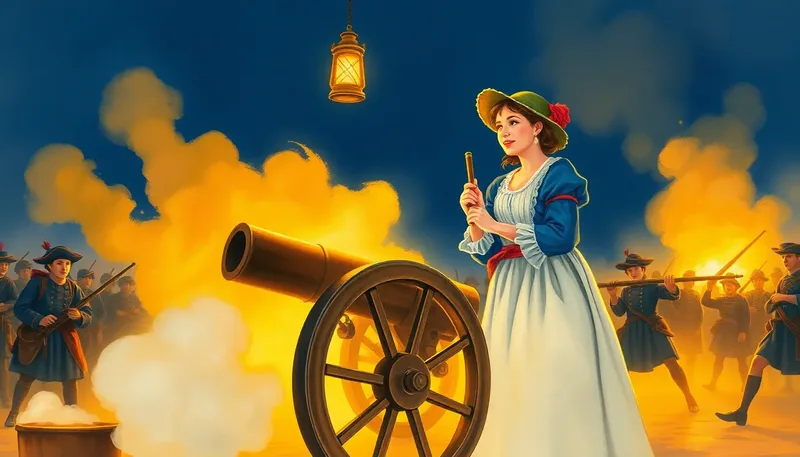
Molly Pitcher Fires the Cannon at Monmouth
4 min · Revolutionary Heroes
📄
Printable Activity Sheet
Discussion questions & fun facts for classroom or family time.
Download Activity Sheet →📖
Discussion Guide
Deepen the learning with questions, vocabulary, and historical context.
View Discussion Guides →💬
Discussion Questions
AI-generated conversation starters for after the story.