5:09
⭐ Premium
Revolutionary Heroes
Ages 11-14
Saving the Guns: Henry Knox and the Cannons of Ticonderoga
✍️ Written by TrueTales Editorial Team
🎙️ Narrated by Lily Caldwell
Henry Knox's impossible winter trek that changed the siege of Boston forever.
Read Along — Story Text
The war was barely six months old, and Boston was losing.
In the autumn of 1775, General George Washington stood on the heights above the city and surveyed a grim picture. His ragged Continental Army had the British troops bottled up inside Boston, but the redcoats had something Washington desperately lacked — cannons. Without artillery, the siege could drag on for years. The revolution might die of patience before a single decisive battle was ever fought.
Then a twenty-five-year-old bookseller from Boston walked into Washington's headquarters and made a proposal so audacious that the general fell silent for a long moment before he spoke.
His name was Henry Knox. He was broad-shouldered, cheerful, and had read every military book in his own shop. He had no formal training as an artillery officer, but he had something rarer: a mind that refused to accept the word impossible.
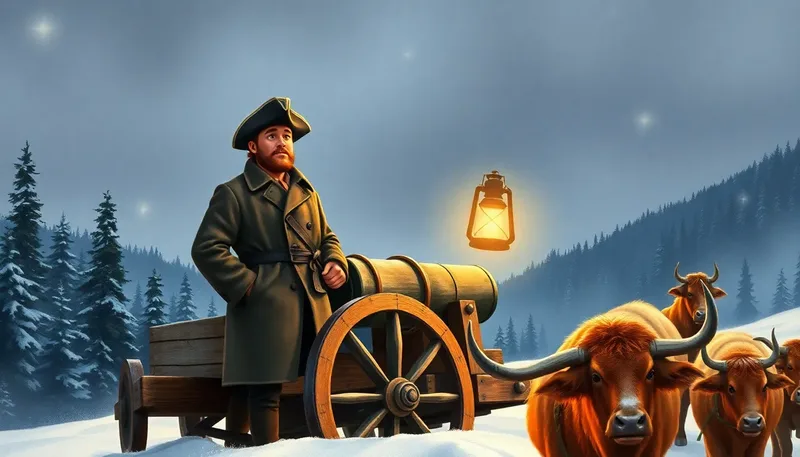
Knox told Washington that Fort Ticonderoga, captured from the British earlier that spring by Ethan Allen and his Green Mountain Boys, held more than fifty cannons. They were sitting silent and unused, nearly three hundred miles away through the wilderness of New York. Knox said he would go get them.
Three hundred miles. In December. Through the Adirondack Mountains.
Washington looked at the young man for a long moment, then said simply, "Do it."
Knox set out in November with his younger brother William and a small crew of teamsters. They traveled north into a world of bare black trees and iron-gray skies. At Fort Ticonderoga, Knox stood before the cannons and felt the first cold drop of doubt. Forty-three artillery pieces and mortars. The lightest weighed three hundred pounds. The heaviest weighed more than a ton. Together they totaled nearly sixty tons of iron and bronze.
"We shall build sleds," Knox announced.
His men stared at him. Then they went to work.
Knox designed massive flat-bottomed sleds from timber he had hauled and shaped by hand. He negotiated with local farmers for teams of oxen — eighty oxen in all, their breath rising in white clouds in the freezing air. He named the cannon train the Noble Train of Artillery, partly as a joke and partly because he believed a thing named nobly would be treated nobly.
The first real crisis came at Lake George. The lake should have been frozen solid, but a warm spell had left the ice treacherous. Knox watched one cannon crack through the surface and plunge into the black water below. His men worked for hours in the cold, their hands bleeding, using ropes and timber levers to drag it back up. Knox never lost his steady voice, never let the despair in his chest reach his face.
"If we stop," he told William quietly that night, "no one else is coming."
They did not stop.
Through the Berkshire Mountains the oxen labored, their hooves slipping on icy slopes, their massive shoulders straining against harnesses that groaned and snapped and were repaired and snapped again. Knox walked every mile on foot beside the animals, guiding, encouraging, solving each new problem as it arrived. Farmers along the route came out of their farmhouses to watch in disbelief, and more than a few quietly joined the effort for a day or a week, moved by something they could not fully name.
On January 27, 1776, Henry Knox arrived outside Boston.
Washington placed the cannons on Dorchester Heights in a single night of furious work. When the British commander, General Howe, looked up from the city at dawn and saw fifty-nine cannon barrels staring down at him from positions his ships could not answer, he ordered the evacuation of Boston that very week.
The siege was over. The city was free.
Henry Knox was twenty-five years old. He had read about war in books, and then he had walked three hundred miles through winter to prove that what he had read was true: that courage, applied with patience and a plan, can move mountains.
And sometimes it can move cannons, too.
Henry Knox
American Revolution
Boston
bravery
cannons of Ticonderoga
Henry Knox story for kids
cannons of Ticonderoga children's story
siege of Boston Revolutionary War
patriotic bedtime story American Revolution
Henry Knox Noble Train of Artillery
American Revolution heroes for kids
Revolutionary War bedtime story
🇺🇸
Unlock 500+ Patriotic Stories
Faith, grit, and American pride — every single night for your family.
Start 7-Day Free TrialNo credit card required
✦ More Like This
Penelope Barker Leads the Edenton Tea Party
2 min · Revolutionary Heroes
Agrippa Hull's Long March Home from Yorktown
2 min · Revolutionary Heroes
Ann Bates Walks Into the Enemy Camp
2 min · Revolutionary Heroes
Lexington Green: The Shot Heard Round the World
2 min · Revolutionary Heroes
📄
Printable Activity Sheet
Discussion questions & fun facts for classroom or family time.
Download Activity Sheet →📖
Discussion Guide
Deepen the learning with questions, vocabulary, and historical context.
View Discussion Guides →💬
Discussion Questions
AI-generated conversation starters for after the story.