4:59
⭐ Premium
Freedom Fighters
Ages all
🎧 25 plays
Tuskegee Airmen: Freeman Field and the Sky Nobody Could Take
✍️ Written by TrueTales Editorial Team
🎙️ Narrated by John Harrison
The Tuskegee Airmen prove that no barrier can ground true courage.
Read Along — Story Text
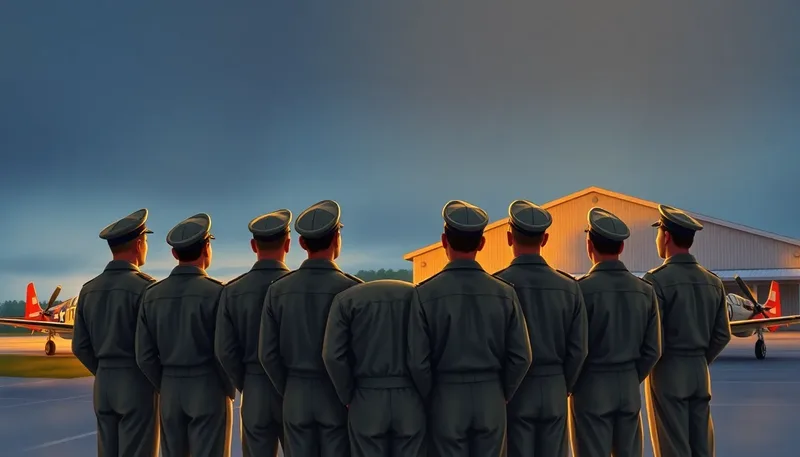
The year was 1945, and the war was still raging across Europe. But tonight, on a quiet air base in Indiana called Freeman Field, the battle was right here at home.
Lieutenant Marsden Thompson was twenty-three years old. He was lean and sharp-eyed, and he could fly a P-51 Mustang the way a hawk rides the wind — easy, powerful, and free. He had trained at Tuskegee, Alabama, alongside hundreds of other young Black men who dreamed of serving their country in the sky.
They were the best pilots the Army Air Forces had ever tested. Their instructors said so. Their flight records proved it. Their hands were steady at ten thousand feet.
But when they arrived at Freeman Field, something felt wrong.
There were two clubs on the base. One for white officers. One for Black officers. Two water fountains. Two waiting rooms. The same country that sent these men to fight Adolf Hitler — a man who believed some people were worth less than others — was treating its own heroes as if they were worth less than others.
Marsden stood outside the white officers' club one evening with his friend, Lieutenant Roger Terry. The warm Indiana air smelled of cut grass and airplane fuel.
"You know what's inside that door?" Roger said quietly.
"Same chairs. Same tables. Same coffee," Marsden answered.
"Then I think we ought to go in," Roger said.
And so they did. Not loudly. Not with anger. They walked in with their backs straight and their uniforms pressed, because they were officers of the United States Army Air Forces. They belonged everywhere this flag flew.
Within days, more than one hundred Tuskegee Airmen did the same. One by one, in twos and threes, they walked calmly through that door.
The base commander had them arrested. One hundred and one men, taken into custody for asking to be treated as Americans.
The brig was crowded. The men were tired. But not one of them said he was sorry.
Back home in Tuskegee, word spread. The Pittsburgh Courier, a great Black newspaper, carried the story. Letters flooded into Washington. Thurgood Marshall, a young lawyer who would one day become a Supreme Court Justice, began taking notes.
Colonel Benjamin O. Davis Jr. — the Tuskegee Airmen's own commander, a man of granite dignity — wrote letters to the War Department. He was patient. He was precise. And he was relentless.
The charges against most of the men were quietly dropped. The Army could not explain, even to itself, how it could ask men to die for freedom and deny them a cup of coffee.
And in the skies over Europe, the Tuskegee Airmen kept flying. They flew more than fifteen thousand missions. They escorted bombers deep into Nazi territory. Their planes were painted with red tails, and enemy fighters learned to fear those red tails. They never lost a bomber to enemy attack on a single escort mission — a record no other unit matched.
When the war ended, President Harry Truman asked his advisors a question he could not shake: How can America ask men to die for democracy and refuse to give it to them?
In 1948, he signed an order. The United States military was to be integrated. No more two doors. No more two clubs. One America.
It did not fix everything. There were long fights still ahead. But the Tuskegee Airmen had helped turn a key in a very heavy lock.
Tonight, young listener, look up at the night sky. Find the stillest, brightest star you can. Those men flew higher than that star felt from the ground. They flew with skill. They flew with dignity. They flew with faith that their country would one day catch up to its own promises.
And slowly, bravely, it did. Sleep well, knowing that kind of courage is part of who we are.
🇺🇸
Unlock 500+ Patriotic Stories
Faith, grit, and American pride — every single night for your family.
Start 7-Day Free TrialNo credit card required
✦ More Like This
James Reeb Walks Into the Dark for Justice
2 min · Freedom Fighters
Harriet Beecher Stowe Writes the Book That Changed America
2 min · Freedom Fighters
Zitkala-Sa Sings Her People's Song
4 min · Freedom Fighters
Diane Nash Plans the Freedom Rides of 1961
2 min · Freedom Fighters
📄
Printable Activity Sheet
Discussion questions & fun facts for classroom or family time.
Download Activity Sheet →📖
Discussion Guide
Deepen the learning with questions, vocabulary, and historical context.
View Discussion Guides →💬
Discussion Questions
AI-generated conversation starters for after the story.