5:02
⭐ Premium
Founding Fathers
Ages all
Alexander Hamilton's Last Night of Letters for Liberty
✍️ Written by TrueTales Editorial Team
🎙️ Narrated by Dorothy Mae
Alexander Hamilton chooses country over ambition in America's first great election crisis.
Read Along — Story Text
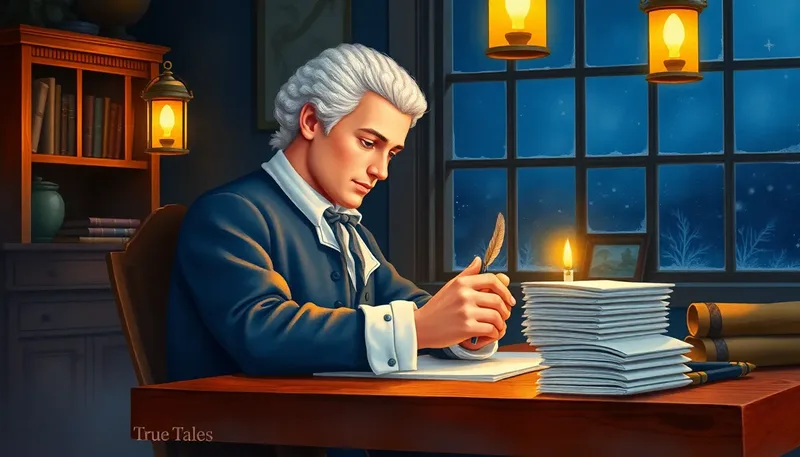
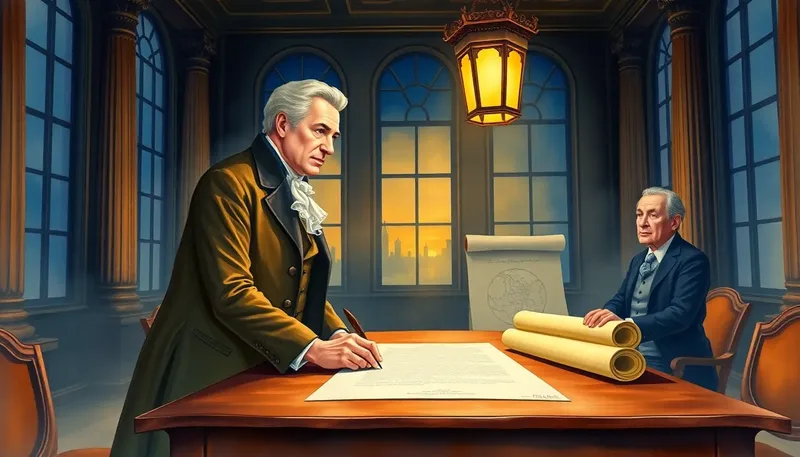
The city of Philadelphia had grown quiet, but in a small room in New York, a candle still burned. Alexander Hamilton sat at his desk, a quill pen in his hand, and stared at a blank page. Outside, the winter wind rattled the shutters. Inside, the whole future of the United States felt balanced on the edge of his next decision.
It was the year 1800, and America was in trouble.
The presidential election had ended in a tie. Two men had received exactly the same number of votes from the Electoral College: Thomas Jefferson and Aaron Burr. According to the Constitution, when that happened, the House of Representatives had to choose the winner. And the men in the House — many of them — were looking to Alexander Hamilton for guidance.
Hamilton was one of the most powerful voices in America. He had helped write the Constitution. He had built the country's first Treasury and its first bank. He had fought beside Washington in the Revolution, charging through cannon smoke at the Battle of Yorktown. People listened when Alexander Hamilton spoke.
But here was the hard part. Hamilton did not like Thomas Jefferson. They had argued for years, loudly and bitterly, about what kind of country America should be. Hamilton believed in a strong central government. Jefferson believed in keeping power close to the people. They disagreed about almost everything.
And yet.
Hamilton picked up his pen.
He thought about Aaron Burr. Burr was charming and clever, but Hamilton had watched him for years. Burr, Hamilton believed, cared about one thing above all others: himself. He would twist the young nation to serve his own ambitions. Hamilton had seen it happen to republics in history books — the moment a leader chose personal power over the public good, freedom began to fade.
Hamilton dipped his pen in the ink and began to write. Letter after letter, page after page, he wrote to the Federalist members of the House of Representatives. His hand moved quickly even as the candle burned lower.
"Jefferson," he wrote, "is wrong about many things. But he loves this country. He believes in something greater than himself. A republic can survive a president it disagrees with. It cannot survive a president who has no principles at all."
Hamilton sealed each letter with wax and sent them out into the cold night with trusted messengers. He knew what he was doing. He was risking everything — his reputation, his friendships, his standing in the only party that had ever supported him. Many Federalists despised Jefferson. They would be furious with Hamilton for helping him.
But Hamilton pressed on.
Weeks passed. The House of Representatives voted. And voted again. And again. Thirty-five times the House cast ballots, and thirty-five times no one won a majority. Then, on the thirty-sixth ballot, enough representatives changed their votes. Thomas Jefferson was elected the second President of the United States.
Hamilton sat quietly when he heard the news. He did not celebrate. He simply nodded, the way a man does when he knows he did the right thing, even though it cost him something real.
He walked to the window and looked out at the winter sky. The stars were bright and cold above New York. The republic was still standing.
Years later, historians would call this moment the Revolution of 1800 — the first peaceful transfer of power between opposing parties in the history of the world. America had shown that a free people could disagree, could argue, could even tie an election, and still choose wisely without a single shot being fired.
And in the middle of that miracle, quietly, by candlelight, Alexander Hamilton had chosen his country over his rivalry.
That is what real courage looks like. Not always a battlefield. Sometimes it is a desk, a candle, and the bravery to do what is right when it is the hardest thing in the world.
🇺🇸
Unlock 500+ Patriotic Stories
Faith, grit, and American pride — every single night for your family.
Start 7-Day Free TrialNo credit card required
✦ More Like This
Gouverneur Morris Writes the Words That Echo Forever
2 min · Founding Fathers
James Monroe Stands Alone Before Napoleon
2 min · Founding Fathers
Alexander Hamilton Defends the Constitution at Poughkeepsie
2 min · Founding Fathers
James Monroe Sails Into the Heart of France
2 min · Founding Fathers
📄
Printable Activity Sheet
Discussion questions & fun facts for classroom or family time.
Download Activity Sheet →📖
Discussion Guide
Deepen the learning with questions, vocabulary, and historical context.
View Discussion Guides →💬
Discussion Questions
AI-generated conversation starters for after the story.