5:06
⭐ Premium
Faith & Courage
Ages 7-10
Elizabeth Kenny Heals the Children No One Believed
✍️ Written by TrueTales Editorial Team
🎙️ Narrated by Lily Caldwell
Sister Elizabeth Kenny fights to heal children when no one believes her.
Read Along — Story Text
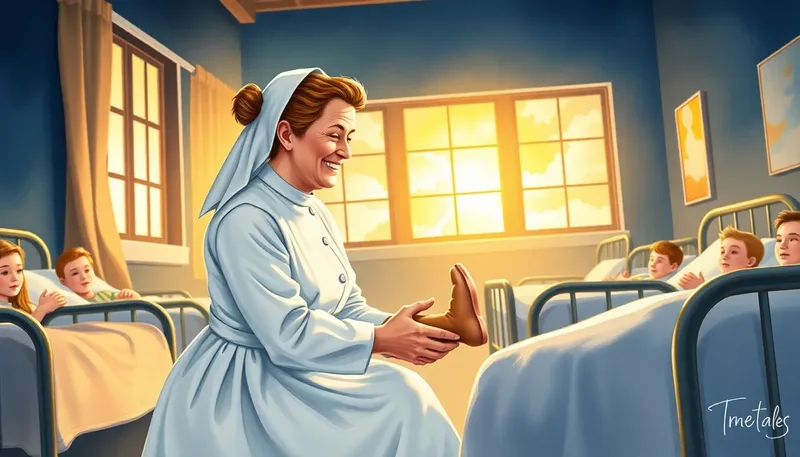
The year was 1940, and a terrible sickness was sweeping across America. It was called polio, and it struck children without warning. One morning a child might be running through a field. By evening, that same child could not move their legs at all. Parents were frightened. Doctors did their best. But for many children, the treatment left them with twisted limbs, locked in heavy metal braces, their muscles stiff as old leather.
Then a woman named Elizabeth Kenny stepped off a ship in California, carrying nothing but a battered suitcase and an unshakeable belief that she could help.
Elizabeth had grown up in the rugged bush country of Australia, where doctors were often days away by horse. She had taught herself nursing from a worn medical handbook, and she had spent years caring for the poor and the sick in places most people never went. Friends called her Sister Kenny, which was the Australian title for a trained nurse. She had first encountered polio back in 1911, treating children in the outback when no textbook told her what to do. So she prayed, and she watched, and she listened to what the children's bodies were telling her.
What she saw surprised her. The muscles were not truly paralyzed forever. They were in pain. They were in spasm. They needed warmth and gentle movement, not rigid braces that held them still.
She began wrapping the sore muscles in strips of warm, moist cloth. Then she moved the children's limbs slowly, carefully, over and over, teaching the muscles to remember what they were supposed to do. Some children began to move again. Some stood. Some walked.
But when Elizabeth Kenny arrived in America with her methods, many doctors shook their heads. Her ideas went against everything taught in medical schools. She had no university degree. She was a woman, a foreigner, and she was daring to tell experts they were wrong.
"Send her home," some said.
She did not go home.
Instead, Elizabeth walked into a hospital in Minneapolis, Minnesota, and asked for a chance to show what she could do. The doctors agreed, if only to prove her wrong. She was given a ward full of children who had not improved with standard care. She rolled up her sleeves and got to work.
Every morning she sang softly as she heated the wool cloths and pressed them gently against trembling small legs. She told the children stories. She looked into their eyes and said, "Your muscle is not dead. It is only frightened. We will wake it up together."
She prayed over those children every single day. She believed with her whole heart that God had made these bodies to heal, and that her job was simply to help them remember how.
Weeks passed. Then something remarkable happened. Children who had lain flat on their backs began to prop themselves up. A boy named Tommy, who had not moved his right arm in four months, reached out and touched his mother's hand. His mother wept. Elizabeth quietly thanked God and moved on to the next bed.
By 1942, the Elizabeth Kenny Institute had opened in Minneapolis. Thousands of children came from across the country. Doctors who had once doubted her traveled to watch her work. The United States Congress invited her to speak. A Gallup Poll in 1951 named her one of the most admired women in the world, second only to Eleanor Roosevelt.
She never grew rich. She gave away most of what she earned to keep her clinics running. She said she had not come to America for money. She had come because the children needed her.
Elizabeth Kenny died in 1952 in Australia, but her methods lived on. The warm cloths, the gentle movement, the patient belief that a hurt body could heal — these became the foundation of modern physical therapy.
She listened when others gave up. She believed when others doubted. And because she did, children walked again.
Elizabeth Kenny
faith and healing
polio history
courage
perseverance
Elizabeth Kenny story for kids
Sister Kenny polio nurse bedtime story
faith and courage American history kids
patriotic bedtime story children
polio treatment history for children
brave nurse story kids
Sister Kenny Minneapolis healing
🇺🇸
Unlock 500+ Patriotic Stories
Faith, grit, and American pride — every single night for your family.
Start 7-Day Free TrialNo credit card required
✦ More Like This

Mitsuo Fuchida's Long Road Back to Grace
4 min · Faith & Courage
Chaplain Emil Kapaun's Brave Heart in Korea
5 min · Faith & Courage
Corrie ten Boom's Hiding Place and Unbroken Faith
4 min · Faith & Courage
Corrie ten Boom's Hiding Place and Unbroken Faith
5 min · Faith & Courage
📄
Printable Activity Sheet
Discussion questions & fun facts for classroom or family time.
Download Activity Sheet →📖
Discussion Guide
Deepen the learning with questions, vocabulary, and historical context.
View Discussion Guides →💬
Discussion Questions
AI-generated conversation starters for after the story.