4:56
⭐ Premium
Revolutionary Heroes
Ages all
Amos Doolittle Draws the Shot Heard Round the World
✍️ Written by TrueTales Editorial Team
🎙️ Narrated by Margaret Sinclair
How Amos Doolittle engraved the story of Lexington and Concord for a new nation.
Read Along — Story Text
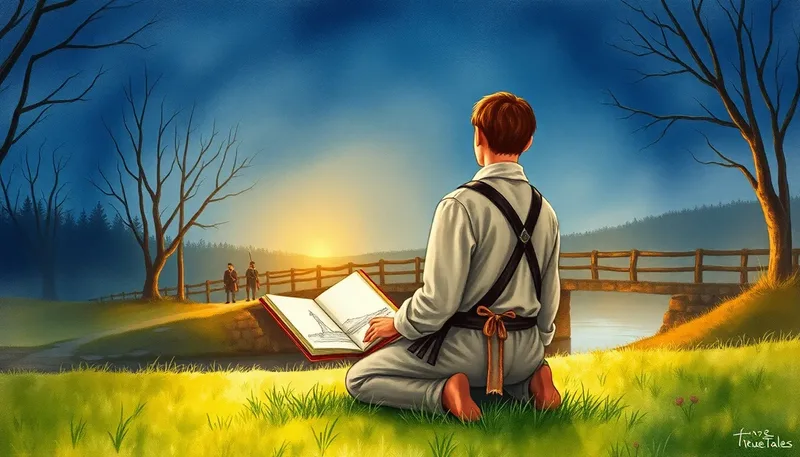
The spring mud had barely dried on the road from Lexington to Concord when a young man named Amos Doolittle arrived with a sketchbook tucked under his arm.
Amos was twenty years old. He was a silversmith's apprentice from New Haven, Connecticut, and he had marched north with his militia company just after the battles of April 19, 1775. By the time he reached the towns, the shooting was over. The Redcoats had retreated all the way back to Boston. But the story of what had happened — the farmers who stood their ground, the soldiers who fired first, the bridge where America pushed back — that story was still alive in the air.
Amos walked every inch of those fields. He stood at the Lexington Green and stared at the worn grass where Captain John Parker had lined up his seventy-seven militiamen before dawn. He crossed the Old North Bridge at Concord and looked down at the cold, dark water rushing beneath it. He talked to farmers who had heard the shots from their barns. He talked to women who had watched from windows, holding their children close.
He drew everything he saw. And he asked every question he could think of.
Back in New Haven, Amos worked with a painter named Ralph Earl, who had also visited the battlefields. Ralph painted four scenes in oil — the Lexington alarm, the first volley, the fight at the bridge, and the long British retreat. Then Amos took those paintings and did something extraordinary.
He engraved them onto copper plates, line by careful line, pressing a tiny steel tool into bright metal with steady hands. Every tree, every soldier, every curl of musket smoke — he cut it all by hand. It took weeks. His fingers ached. The work required such stillness that he sometimes forgot to breathe.
But when the prints came off those plates in December 1775, they were unlike anything Americans had ever seen.
There was the green at Lexington, with rows of British Regulars firing into the morning mist. There was the bridge at Concord, where the Minutemen stood shoulder to shoulder and held their ground. There was the ragged British column pulling back through Menotomy under fire from every hedgerow and stone wall.
For the first time, ordinary people who lived far from Massachusetts could see exactly what had happened on the day the Revolution began. They could see the faces of the men. They could see the smoke and the chaos and the bravery. A picture, people said, told the truth in a way that words alone could not always reach.
Amos sold the four prints for eight pennies each. He never became famous the way generals do. He never led a charge or crossed a frozen river at night. But what he made lasted.
Those four engravings are still with us today — the oldest surviving visual record of the American Revolution. Historians study them. Museums treasure them. And children who look at them more than two hundred years later can stand at Lexington Green and Concord Bridge just the way Amos did, and feel the weight of what happened there.
Amos Doolittle believed that a free people needed to remember what they had fought for. He believed that truth, set down carefully and shared widely, was its own kind of courage. He picked up his engraving tool instead of a musket, and he helped a young nation see itself.
That night, as you close your eyes, think about the things you notice that others might walk past. A story waiting in a muddy field. A memory that deserves to be kept. Sometimes the bravest thing a person can do is pay attention, and then find a way to share what they have seen.
Sleep well, young patriot. The whole country is glad someone was watching.
🇺🇸
Unlock 500+ Patriotic Stories
Faith, grit, and American pride — every single night for your family.
Start 7-Day Free TrialNo credit card required
✦ More Like This
Hercules Mulligan's Secret Tailor Shop
5 min · Revolutionary Heroes
Molly Pitcher Fires the Cannon at Monmouth
4 min · Revolutionary Heroes

Lydia Darragh Listens at the Door for Liberty
4 min · Revolutionary Heroes
Wentworth Cheswell Rides for Liberty
4 min · Revolutionary Heroes
📄
Printable Activity Sheet
Discussion questions & fun facts for classroom or family time.
Download Activity Sheet →📖
Discussion Guide
Deepen the learning with questions, vocabulary, and historical context.
View Discussion Guides →💬
Discussion Questions
AI-generated conversation starters for after the story.